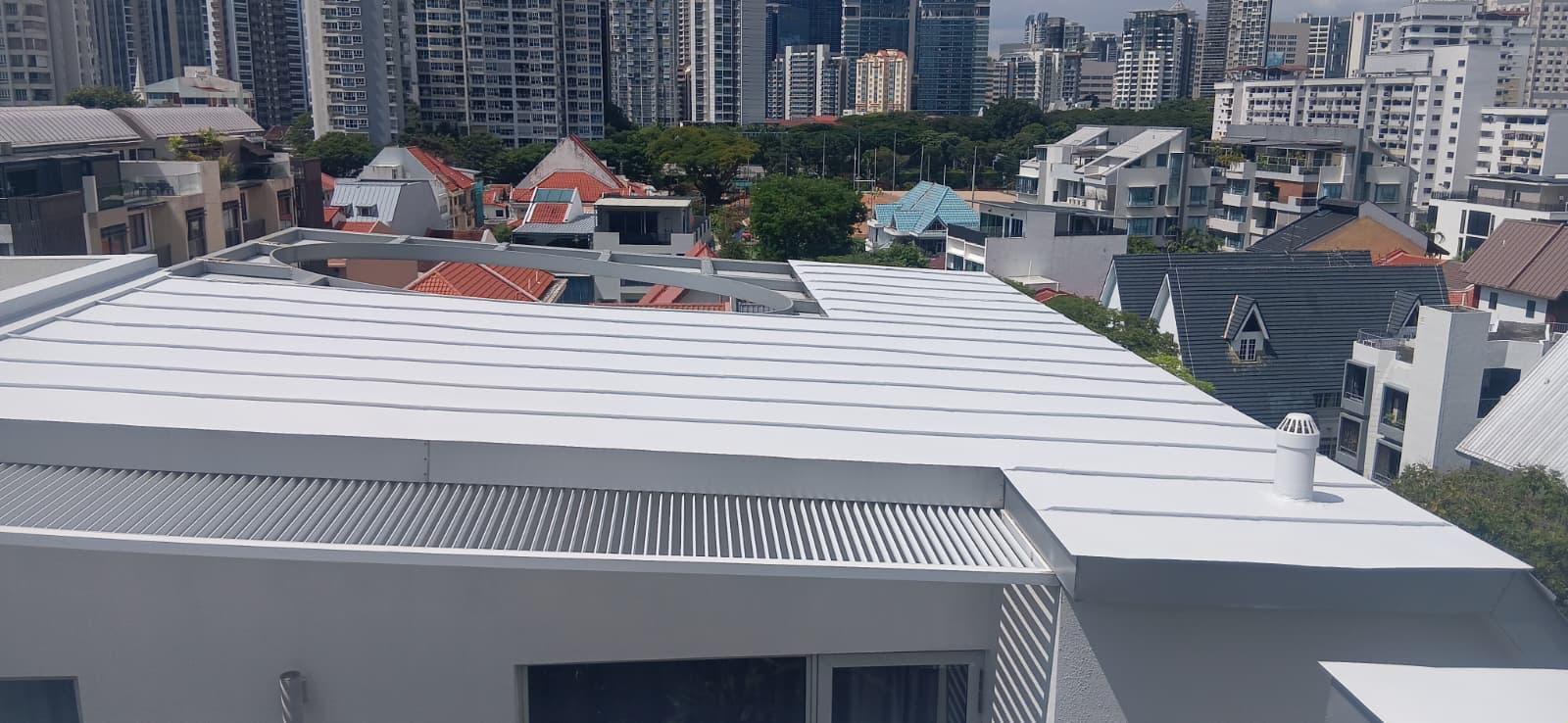
Roof waterproofing in Singapore is not optional — a leaking flat roof or podium deck is the single most expensive building defect to ignore. The membrane is small money. The damage it prevents — saturated slabs, corroding rebar, ruined ceilings, displaced tenants — is the big money. Done correctly, an industry-certified roof membrane system in Singapore's climate lasts 15+ years.
Why rooftops in Singapore fail.
Before we specify a system, we diagnose the roof leak. Roof leak repair starts with knowing exactly where the water enters — and that is rarely where the stain appears on the ceiling below. Water travels horizontally along the slab before finding a surfacing point, which means the visible damage on the top-floor ceiling could be metres from the actual membrane failure on the roof above. Our diagnosis process uses moisture mapping and thermal imaging to trace the water path back to the entry point. Only then do we specify whether the scope is a localised roof leak repair, a strip-and-re-membrane of the affected bay, or a full rooftop system replacement.
Singapore is one of the harshest environments on the planet for a roof membrane. Daily UV load, surface temperatures above 60 °C, monthly thermal cycling, and 2,400 mm of annual rainfall — most of it falling in violent short bursts. Three failure modes account for 90% of the rooftop leaks we attend:
- Membrane embrittlement. UV breaks the polymer chain. The membrane goes from elastic to brittle, cracks under thermal movement, and starts admitting water at the surface.
- Upstand and parapet detail failure. The flat field of the membrane often outlives the upstands. Termination at parapet walls, scuppers and pipe penetrations is where 70% of roof leaks originate.
- Ponding. Inadequate falls at the original screed mean water sits on the membrane for days. Constant immersion accelerates every other failure mode. Ponding on the roof surface — where falls are inadequate, rainwater sits on the membrane for days, accelerating UV degradation and increasing hydrostatic load on every crack and lap joint.
Already seeing stains on the top-floor ceiling? The slab has been saturated for weeks by the time staining appears. Don't wait for the next monsoon — book a free roof inspection this week.
Three system families — which one is right.
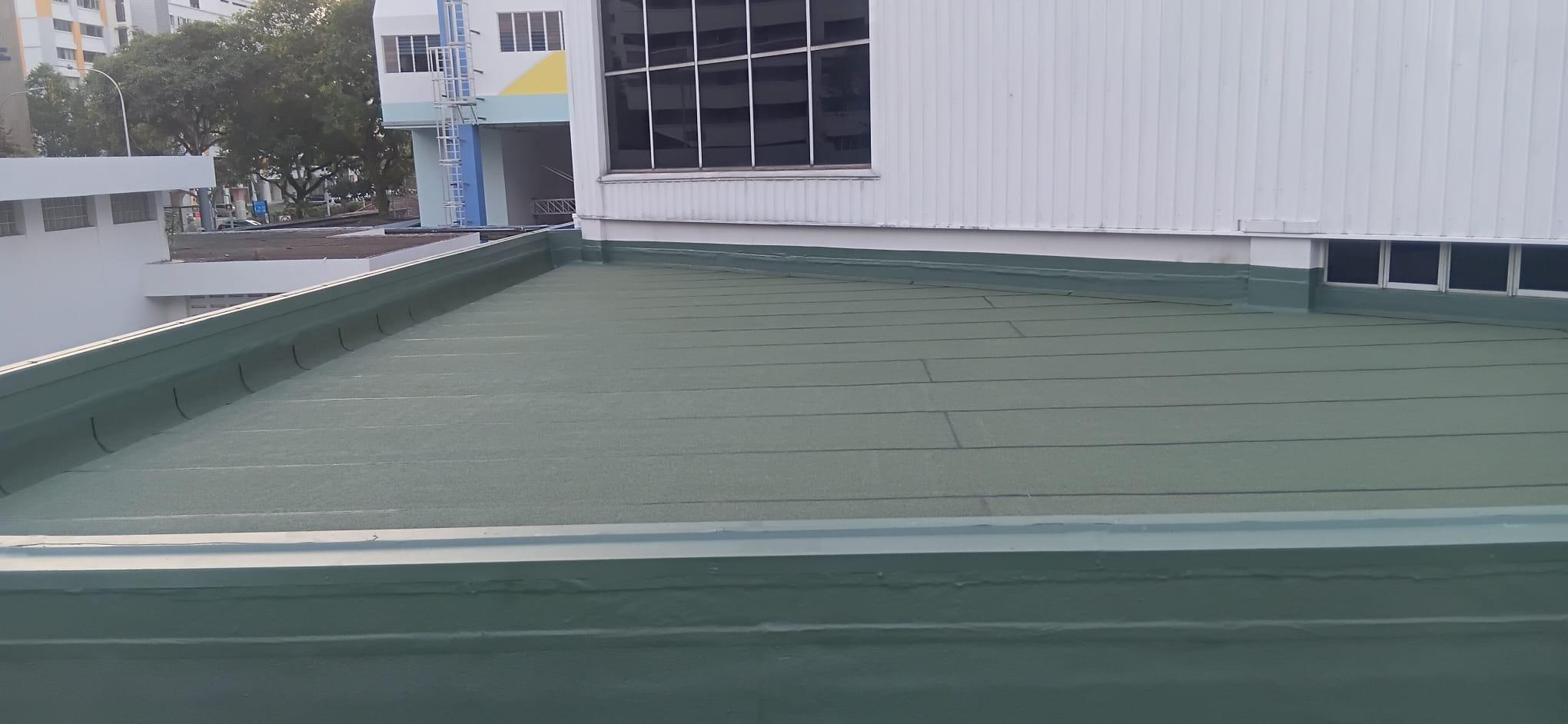
We specify roof waterproofing in Singapore from three manufacturer-certified system families. Each has a sweet spot.
Polyurethane (PU) liquid membrane
Two-component liquid-applied PU. Seamless, crack-bridging, UV-stable, fully adhered. Our most specified PU membrane roof system for Singapore's climate. Ideal for: exposed RC roofs, podium decks with complex geometry, planter boxes. Lifespan: 12–15 years.
Bituminous torch-on / SBS
Pre-formed modified bitumen sheets, torch-fused or self-adhesive. Mechanically tough, heavy-duty. Torch-on membrane waterproofing uses modified bitumen sheets heat-fused to the substrate — our preferred system for large, flat podium waterproofing scopes where mechanical toughness matters. Ideal for: trafficked podiums, large flat fields, retrofit over existing failed membrane. Lifespan: 15–20 years.
Acrylic / hybrid coating
Water-based acrylic with UV-reflective pigments. Lighter scope, faster install. Ideal for: residential RC roofs in good substrate condition, cool-roof applications. Lifespan: 7–10 years.
Crystalline cementitious (secondary line)
For negative-side treatment of podium soffits and basement roofs where positive-side access is blocked. Used as a complement, not a substitute, for a primary roof membrane.
What's actually in our rooftop scope.
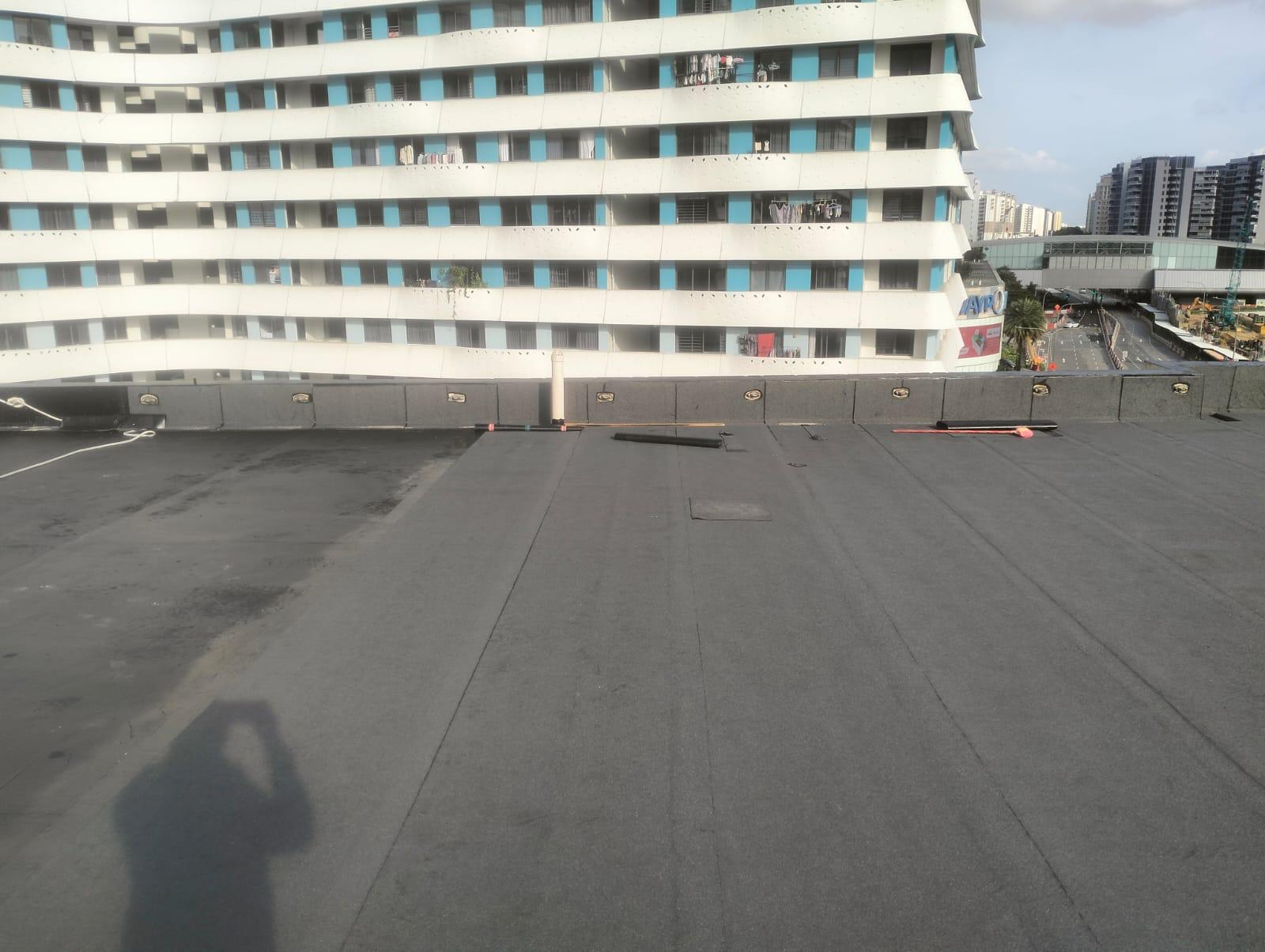
A proper rooftop scope is never just "paint on a membrane." Our standard spec for an exposed RC roof or podium covers eleven items:
- Strip-out. Remove the existing failed membrane down to sound substrate. Cart away.
- Substrate inspection. Map cracks, spalls, hollow areas. Anything structural is flagged for repair before membrane.
- Crack treatment. Static cracks routed and filled with PU sealant. Dynamic cracks bridged with fabric tape in the membrane.
- Falls correction. Where ponding is severe, we re-screed local low spots before the membrane goes down.
- Primer. Manufacturer-specified primer rolled across the entire field. Coverage logged.
- First membrane coat. Full coverage. Wet-film thickness verified.
- Fabric reinforcement at all details. Polyester scrim bedded into every upstand, scupper, pipe penetration, expansion joint and parapet termination. This is the difference between a roof that holds and a roof that leaks at year three.
- Second membrane coat. Perpendicular pass. Wet-film thickness verified every 10 sqm.
- UV top coat / protection layer where the system specifies it.
- 24-hour rain test. Or 48-hour static pond test if drainage allows.
- Handover. Photo report of every layer, system data sheets, signed warranty certificate.
Process — typical programme.
warranty
(bituminous)
handover
specification
Warranty.
Standard cover for the Shieldguard roof membrane system:
- 10 years on PU and bituminous systems applied to a sound substrate with full upstand detailing.
- 5 years on acrylic and cool-roof refresh scopes.
- 2 years on remedial / patch scopes.
Warranty certificate is issued at handover and carries a single Shieldguard reference number. If you ever need to call back on it, you talk to the same project manager who delivered the original job.
Rooftop waterproofing FAQs.
Related pages: External wall waterproofing · Ceiling leak diagnosis · Façade painting